
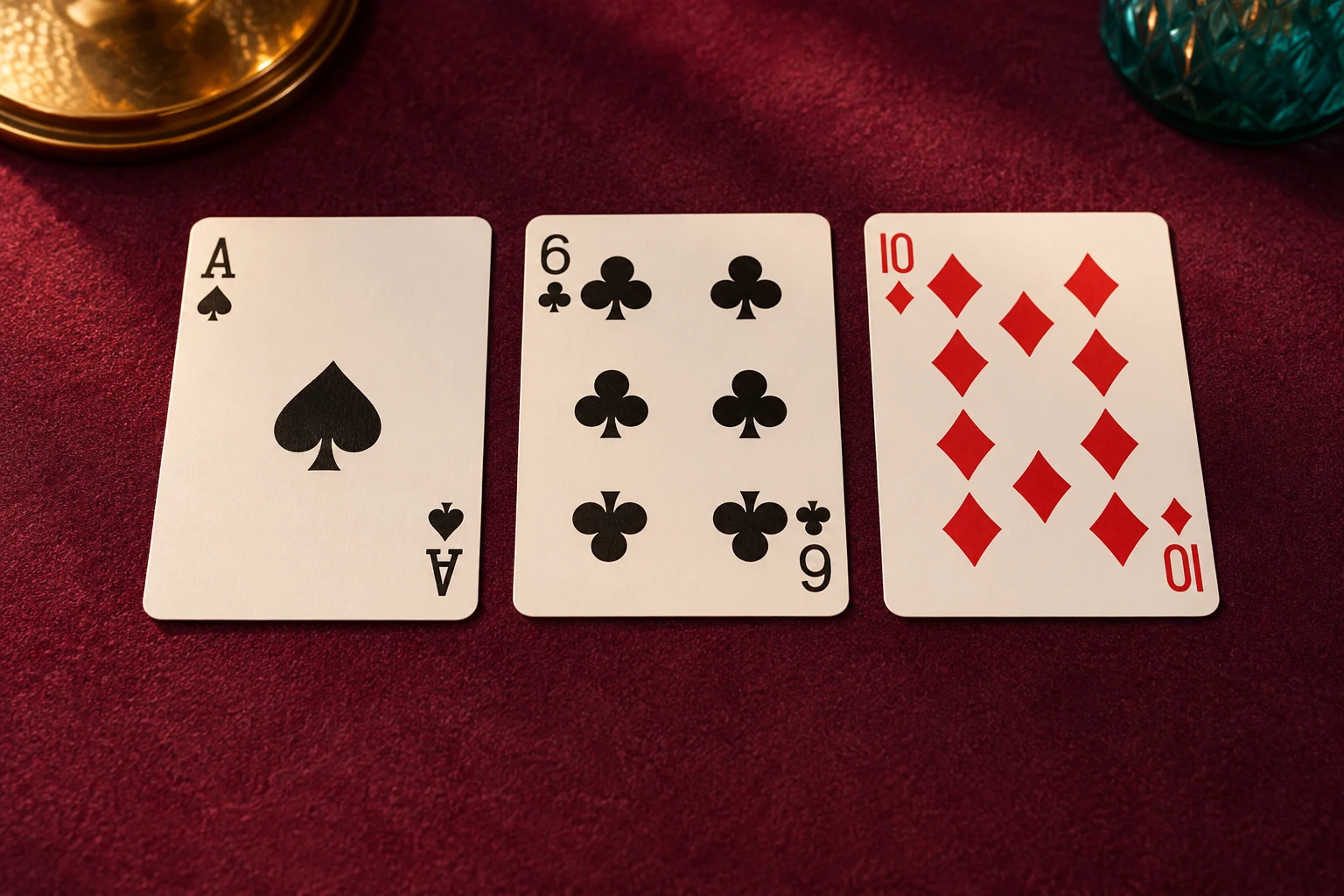
Picture a learner at a practice blackjack table with virtual chips. Two cards arrive: an ace and a six. The pair looks harmless, yet the total is unsettled. The ace may count as eleven, giving seventeen, or as one, giving seven. If a ten-value card comes next, the ace at eleven would push the hand to twenty-seven, which is over the limit. The ace must therefore drop to one, and the hand settles at seventeen.
This article is a learning guide to reading blackjack hands. It treats PlayWSOP’s free-play page as an external virtual-chip example, not as evidence that any particular blackjack title or provider is available on Granawin. Granawin’s supplied categories list casino games and live tables, and the points below concern terminology and hand reading rather than any named inventory.
How Card Values Build a Total
Blackjack counting is simple until the ace appears. Number cards from two to ten keep their face value. Jacks, queens and kings each count as ten. Only the ace is flexible: it can count as one or as eleven, and the player does not fix that choice in advance. The hand’s total is simply the arrangement that serves the hand best at that moment, which usually means using eleven when it does not push the total past twenty-one.
Take a hand of ace and six. Counting the ace as eleven gives seventeen. Counting it as one gives seven. Both totals are arithmetically true, but the first is the usable total because it is higher and still under twenty-one. Now deal a five. The ace must now count as one, because eleven plus six plus five would be twenty-two. The usable total becomes twelve. Nothing on the table has been renamed; the same ace has changed its practical value as the hand grew.
A hand is often described as soft when an ace can still be counted as eleven without busting, and hard when it cannot. That description is useful shorthand, not a label printed on the card. A hand of ace, six and five contains an ace, but that ace counts as one, so the total of twelve behaves as a hard hand. Readers who treat every hand containing an ace as soft will misread such situations. The test is whether the eleven-count keeps the total at twenty-one or below.
Natural Blackjack Versus a Later 21
A natural blackjack is an ace together with a ten-value card in the first two cards. It is a specific opening combination, not simply any total of twenty-one. This distinction matters because tables commonly describe the natural separately when they explain how a round is settled, and because a later arrival at twenty-one is a different event even though the arithmetic looks identical.
Suppose three cards are dealt as seven, seven and seven. The total is twenty-one, and the hand is strong, but it was not dealt as an ace and a ten-value card. Under the terminology used in the PlayWSOP example, it is a twenty-one reached through hitting, not a natural. A learner should therefore avoid saying that every hand totalling twenty-one is a blackjack. The phrase natural blackjack refers to the opening combination.
Hit and Stand as Player Actions
Two action labels appear on almost every blackjack table: hit and stand. Hit asks for another card. Stand keeps the current hand and passes the decision onward. These are requests about the hand, and they are best understood through the count rather than through a promise about results. A player who hits takes on the possibility that the next card will raise the total too far; a player who stands accepts the total as it is.
Return to the ace and six. The usable total is seventeen. If the player stands, the hand remains at seventeen. If the player hits and receives a ten-value card, the ace must count as one, so the total becomes seventeen again: one plus six plus ten. If the player hits and receives a four instead, the ace can stay at eleven, and the total becomes twenty-one. The same action, hitting, produces different totals depending on which card arrives, which is why the count is read fresh after every card.
Other action words exist at many tables, such as double and split, but their availability is conditional. A table may permit doubling only on certain totals or only at particular moments, and splitting applies when the opening hand contains a pair. A learner should not treat these words as universal rights. Read the table’s rules for when an action is offered, then apply the hand-reading skills above. The action label describes what may be requested, not what outcome it will produce.
Working Through an Original Round
Consider a narrated round at a virtual table used purely for practice. Assume the practice display shows both hands as the round unfolds. The player is dealt a nine and a seven, a hard total of sixteen. The player chooses to hit and receives a four, bringing the total to twenty. The player then stands. The practice display shows the dealer’s cards as a ten and a six, so the dealer’s count is read by the same value rules: ten plus six is sixteen, and any further card changes it. No reveal order from a real casino is claimed here; this is arithmetic practice.
Now vary the story. Suppose the player had instead been dealt ace and five, a soft sixteen, because the ace can count as eleven. Hitting and receiving a nine would force the ace to one: one plus five plus nine is fifteen, a lower total than before. Hitting and receiving a five would allow the ace to stay at eleven: eleven plus five plus five is twenty-one. The learner can see that the descriptive word soft does not by itself settle the next total; it only tells us that an ace is currently usable as eleven.
This kind of narrated hand is useful because it trains attention on the cards rather than on a prediction. Notice also that a side bet, where a table offers one, would be a separate arrangement with its own rules and its own settlement. The main hand’s total and the side bet’s outcome should not be merged in the reader’s mind. If a table shows a side bet area, the table’s own explanation governs it, and the optional nature of such games is part of the PlayWSOP example as well.
Dealer Rules Need Table-Level Care
Dealer behaviour is where learners most often overgeneralise. Specific tables can use different dealer rules, for example whether the dealer stands on all seventeens or hits a soft seventeen. Because such rules are set table by table, the selected table’s own help or rule panel governs, and a reader should confirm the wording there rather than rely on a general article or on memory from a different game.
The same caution applies to payout wording, the number of decks in use, and any surrender option. These are table parameters, and they can differ between tables and between versions of a game. A learner who carries a remembered payout ratio from one setting to another may misread the settlement. Before play, the useful questions are: how does this table describe a natural, what does it pay, how many decks are in play, and which action options are offered? The answers should come from the selected table.
Keeping a Clear Personal Record
Take a worked example of the record. Opening cards: ace and six. Usable total: seventeen, soft. Action taken: hit. Card received: ten. New total: one plus six plus ten, which is seventeen, now hard. Actions offered by this table, as stated in its rules: hit and stand. That five-line entry is complete, checkable and free of prediction.
Asking Better Questions at the Table
Slots and other casino formats have their own vocabulary, and readers moving between formats should reset their expectations rather than carry blackjack assumptions across. The slots guide covers a different family of games, where outcomes are not built from player card decisions in the same way. Recognising those differences is part of table literacy. A learner who understands that each format and each table sets its own rules is less likely to misread a label or a record.
The questions worth asking before sitting down are short: how does this table settle a natural, what does it pay, how many decks are in use, does the dealer stand or hit on a soft seventeen, and which extra actions are permitted here? Each answer should come from the table’s own help. Side bets, if offered, have their own settlement and should be checked separately. None of these questions asks for a prediction, and none of them relies on a remembered figure from another game.
Anyone reviewing the site’s general conditions can consult the terms page for the governing framework.