
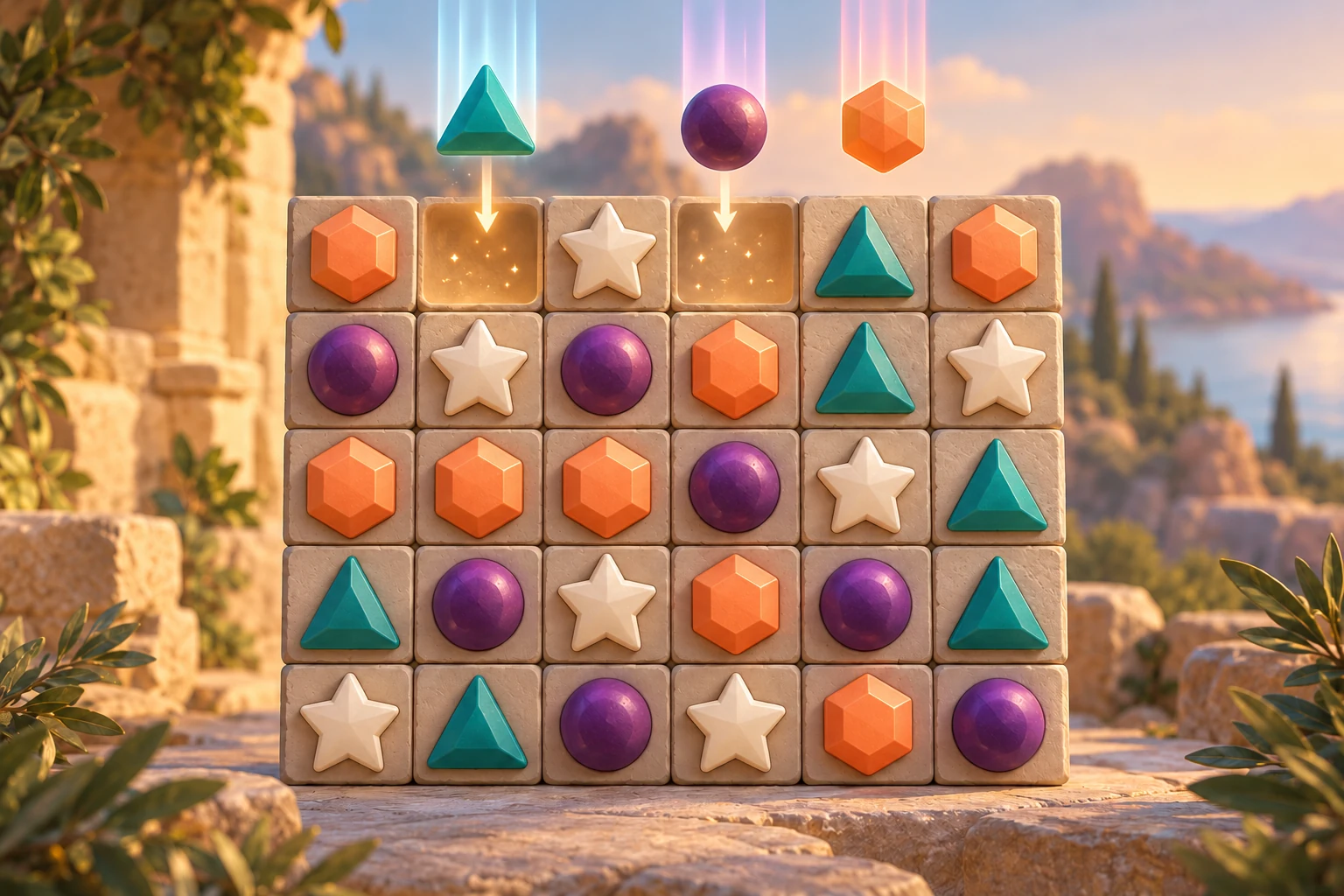
A player presses spin once and a group of matching symbols appears. The symbols flash, vanish and fresh ones drop into the gaps. A second group forms, disappears, and a third appears before the grid settles. The screen has shown several win events, yet only one fresh stake was taken at the start. Untangling that difference is easier if you separate two questions: where symbols sit on the grid, and what the game’s scoring rule says counts as a win. Those are separate pieces of information, and treating them as one is the root of most session-review confusion. The worked examples below are invented for teaching; the named games in the source note are external illustrations only.
Grid Size Is Not the Scoring Rule
The grid tells you where symbols can land. A three-by-three layout has three columns, or reels, and three rows. A six-by-five layout has six columns and five rows. A six-by-eight layout is taller still. None of that tells you which arrangement pays.
The scoring rule does that job, and it usually falls into one of a few families. Fixed paylines check specific paths across the grid. Pay-anywhere counting ignores paths and counts symbols of the same kind wherever they land, often above a minimum number. Connected-cluster scoring looks for groups of matching symbols that touch each other, usually horizontally or vertically, again above a minimum size. A game can also change state after a win, removing symbols and refilling the grid, which is where cascades and tumbles come in.
The practical point is that the same grid can support very different scoring. A six-by-five grid with pay-anywhere counting and a six-by-five grid with twenty fixed lines look similar on screen but behave quite differently when you check a result. When you read any slot, identify the grid and the rule before studying the paytable, not after.
Fixed Paylines: Position Along a Path
Imagine an invented three-by-three game called River Lines. It has five fixed paylines: three horizontal rows, one diagonal from top-left to bottom-right, and one diagonal from bottom-left to top-right. A win on a line requires three matching symbols from the leftmost column to the rightmost, all on the same path. Symbols elsewhere on the grid are irrelevant to that line.
Suppose the top row reads star, star, star; the middle row reads bell, bell, leaf; the bottom row reads leaf, bell, bell. Only the top row qualifies, so the round shows one line win. Now suppose the middle row reads bell, bell, bell and the diagonal from top-left holds bell, bell, bell as well. Two lines qualify, and both are evaluated. A single symbol in the middle can therefore contribute to more than one line, which is normal because each line is checked separately against the paytable.
Where a symbol lands matters in a strict sense: it must sit on the path, in the required columns, in the required order. Adjacency off the path does nothing. This is the classic model many players learn first, and it rewards reading the payline diagram rather than guessing from the picture.
Pay-Anywhere: Count First, Position Second
Now imagine an invented six-by-five game, Atlas Count. Its rule: eight or more matching symbols anywhere on the grid count as a win, regardless of path. There are no lines to trace. Instead you count symbols of each kind.
Suppose a paid spin leaves nine suns scattered across the grid, none of them touching. Under this rule the nine suns qualify as one win. Next spin, eight moons land and five of them happen to be adjacent; adjacency changes nothing here because the rule counts totals, not connections. The moon win is evaluated on the count of eight. Now consider seven stars in a pleasing diagonal: no win, because seven is below the minimum, and a diagonal path has no special meaning under this rule.
This model makes the minimum count the key number to remember. It also changes how you scan a result: sweep the grid for each symbol type and count, rather than following paths. The same visual grid can show a large scatter of symbols that pays nothing because the count is one short, which is precisely the kind of result that confuses players trained on line games.
Connected Clusters: Size Plus Contact
Take an invented six-by-eight game, Terrace Clusters. Its rule: five or more matching symbols connected horizontally or vertically count as a cluster win. Diagonals do not connect. Two groups of the same symbol that only touch at a corner are treated as separate groups, so a corner touch does not merge them.
Suppose six leaves form an L-shape: four across a row and three down a column, sharing one cell. Each leaf touches at least one other leaf along an edge, so all six form one cluster and the group qualifies at six. Elsewhere, four stones sit in a square and a fifth stone touches that square only at a corner. The fifth is not connected under this rule, so the square is a cluster of four, below the minimum, and the lone stone is a cluster of one. Neither qualifies separately, and they do not combine.
Cluster scoring sits between the other two models. Position and contact matter, as with paylines, but there is no required path from left to right, and multiple groups can qualify at once if each reaches the minimum. When you review a cluster result, identify each connected group, check its size against the minimum, and do not merge groups joined only by corners.
One Paid Spin With Several Evaluations
Here is a complete invented round for a six-by-five game called Cascade Field. The rule: eight or more matching symbols anywhere count as a win; a qualifying group is removed, remaining symbols drop, and new symbols fill the empty cells; the refilled grid is then checked again under the same rule. One base stake is taken at the start of the spin. Everything after that is a continuation of that same paid spin, not a new charge.
The first grid settles with nine embers, scattered but all counted. Nine meets the minimum, so the group is removed. The drop brings the remaining symbols down and fills from above. The second grid shows eight embers again. Eight meets the minimum, so a second evaluation pays. The drop happens again. The third grid shows seven embers and a separate group of six crystals. Seven is below the minimum, and six is below it too, so the round ends with no further win.
Count the evaluations: two qualifying groups, one non-qualifying refill. The displayed round total should be read as the sum of the two qualifying evaluations. The third grid is an end state, not a third paying event. Animations can make the removal and refill look like separate happenings, and on some games the settlement or display update may be timed differently; that timing is game-dependent and cannot be assumed from what the animation suggests.
A useful habit after any cascade round is to note the base stake, then list the qualifying groups in order with their symbol and count. That short record reconciles the round total without inventing extra spins. It also shows why the third group did not pay: the rule was checked, and the count fell short.
Reading the Paytable Before You Judge a Result
Each of the three models has a small set of facts you can confirm in the paytable: the grid dimensions, the scoring family, the minimum count for pay-anywhere and cluster games, the payline diagram for line games, and whether a removal-and-refill step follows qualifying wins. On mobile, the paytable may sit behind an information button, but the facts are the same. Reading these before your first spin prevents the common mistake of judging a result by the wrong rule.
Two further points are worth separating. First, the number of win events in a round is not a measure of value on its own; each event is checked against the paytable, and the paytable supplies the amounts. Second, randomness and return-to-player figures describe long-run behaviour of the game, not what a particular spin should produce. A session in which several rounds show cascades and several show single evaluations is not evidence of anything changing. If you are reviewing results across a session, the general guidance in the risk disclaimer is a sensible starting point, and players moving between slot and table formats may find the format distinctions in the live casino guide useful background.